Most homeowners think the contractor decision is about price. It's actually about who owns the seams — between design and build, between drawings and reality. Two main models exist on the Eastside: traditional general contracting, and design-build. The difference matters more than most prospects realize until they're in the middle of a project and the change orders start stacking up.
The traditional model. You hire a designer (sometimes an architect) first. They produce drawings. You shop those drawings to three contractors for competitive bids. Each contractor reviews, asks questions, prices it differently. You pick one. Construction starts. Then: the contractor hits something the drawings didn't anticipate — a load-bearing wall that wasn't documented, plumbing that doesn't follow the assumed routing, a structural condition no one saw from the outside. Or a finish material the designer specified turns out to be on six-month lead time. Or a code requirement the drawings missed.
Each of those moments triggers a change order. The contractor writes it up, the designer reviews it, sometimes redraws a detail. You sign and pay. Multiply that across a 14-week kitchen remodel or a 9-month whole-home renovation and the seams add up. Industry estimates put traditional-model change orders at 10–20% of the original contract value on remodel work — not because anyone's incompetent, but because no one team owns both halves.
Design-build differently. Design-build firms employ (or directly contract) the design talent in-house. The same team that draws also builds. The contract is split in two phases: a preconstruction agreement covers design, structural and mechanical engineering, and permitting — typically 5–10% of total project cost. When you approve those drawings and the budget that comes with them, the main construction contract takes them through framing, mechanical, finishes, and the punch list.
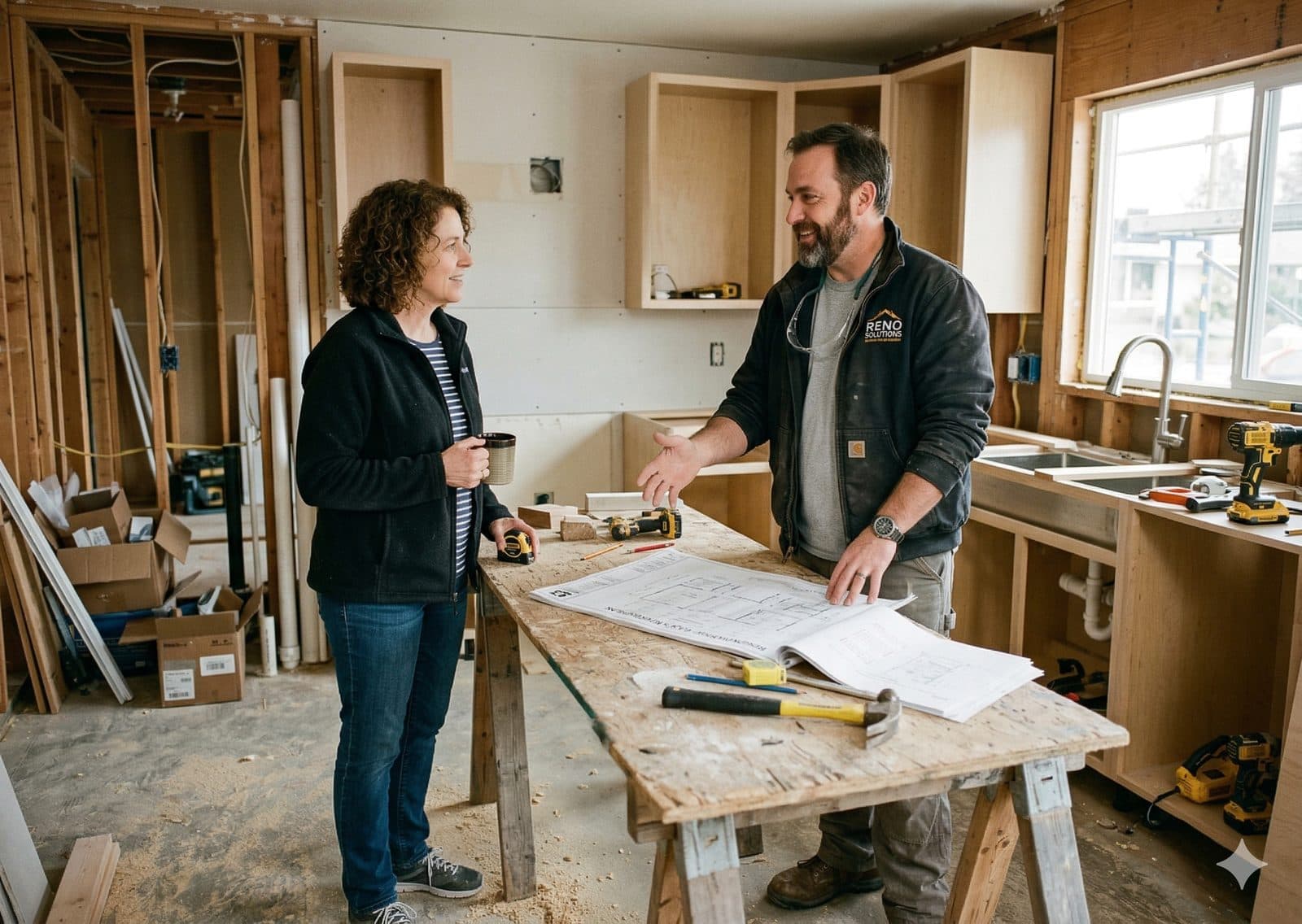
What that looks like in practice. When the team drawing the kitchen layout is the same team that's going to install the cabinets, they design with installation realities in mind. When the framer hits a structural surprise, the architect (in-house) is in the same Slack thread, not waiting on an RFI for two weeks. When a finish material falls through, the team already knows what substitutes work and just makes the swap — no change order ping-pong. The drawings and the build aren't two contracts to reconcile; they're one team's product.
When traditional makes sense. If you already have an architect you love and the project is heavy on custom design (a luxury showpiece, a historic-home restoration, an architecturally significant addition), traditional GC bidding can find you the best builder for that specific designer's vision. Pure GC bidding rewards lowest-price-fits-spec. If the spec is exceptional, you get exceptional builders competing on it.
When design-build makes sense. If you don't already have a designer, and you want one team accountable for the outcome end-to-end, design-build removes the seam. Most Eastside kitchen, bath, and full-home remodels we see fit this model — homeowners want the finished result, not the project management overhead of running two vendors who don't share a P&L.
What to ask either way. Whatever model you pick, ask three questions before signing: (1) Who owns change orders — designer, contractor, or me? The honest answer in traditional GC is usually "you, with the designer and contractor each blaming the other." In design-build it's typically "us, within the budget we already agreed to, unless scope changes." (2) Show me the last three projects this team built, with their original budget versus final cost. A team confident in their estimating will share this. (3) How are unforeseen conditions handled — built into the contract, or charged separately? A 10–15% contingency built into the preconstruction estimate beats a $0 contingency that turns into $40k of change orders.
The honest disclaimer. Design-build is what ERC does, so this read is biased toward it. That doesn't make it the right answer for every project — but it makes the trade-off worth knowing before you commit. If you'd like to walk through which model fits your specific project (including if we'd point you to a traditional GC instead), the free consultation is the right next step.
Ready to Discuss Your Project?
Get a free consultation and estimate from our team. We serve the Greater Seattle area including Redmond, Bellevue, Kirkland, and Sammamish.